The Standing Charge · NOTICE 4 OF 14
The Queue With No Front
2,224 words · about 10 min
Back to The Morkinstar Journals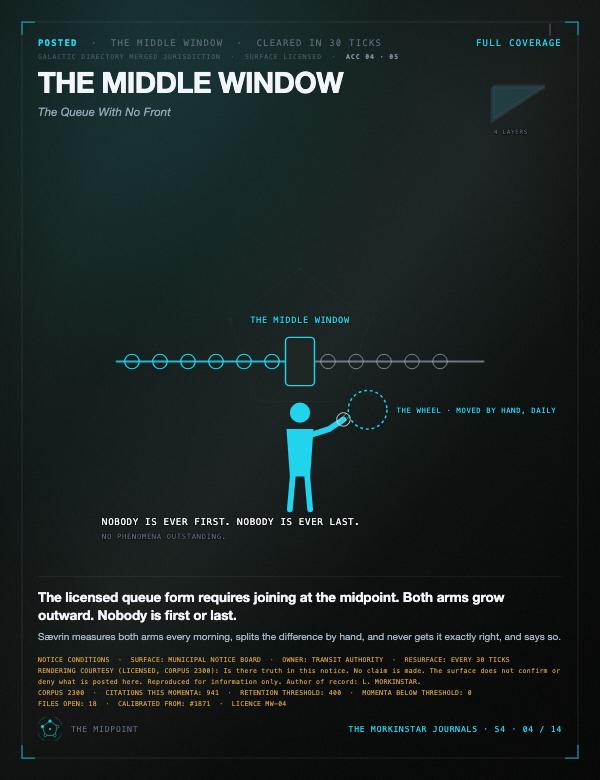
THE MIDDLE WINDOW
Posted · cleared in 30 ticks
Greetings again, my dear readers. I have spent four days in a district called the Middle Window, which is named after a service window in the middle of a room, and which is both the least imaginative district name I have found in this city and the most accurate one.
Here is the room. A hall on a public level, well lit, dry, warm at the ankles, with a floor that falls one in four hundred toward drains at both ends, which I know because a man explained it to me for eleven minutes and I am glad he did. In the centre of the long wall there is a counter with a window in it. On the floor in front of the window there is a painted line about a metre long, and standing on that line is a wooden marker about the height of my forearm, and that marker is the front of the queue and the back of the queue and neither.
Because in this district the licensed queue form requires you to join at the midpoint.
You do not go to the back. There is no back. You come into the hall, you walk to the marker, you take your place beside it, and the person who was beside it moves outward by one, and the person beside them moves outward by one, and so on to the ends of the hall, and this happens in both directions at once, so the queue grows away from its own middle like something being drawn apart at a steady rate. The window serves from the middle outward, alternating, one from the north arm and one from the south arm. Nobody in the Middle Window is ever first. Nobody is ever last.
And it is worse for everybody than a line with a front would be, by about a third on the average wait, and that is not my figure, it is the district's, printed on the wall of the hall at eye height in the district's own signage face.
[Also posted- somebody costed this district's civic pride to two decimal places and then printed the result where the people waiting can read it while they wait. I stood and read it four times. In four days I did not see one other person look at it once. Theirs is plainly the healthier relationship with the number and I would like to acquire it.]
I could not get into the queue, incidentally. A queue here is a rendering service, and there is nothing of me for the service to place, so from the queue's side of it I never arrived. I mention it once because it is why a man gave me a job on the second morning, and then I am going to leave it alone, because you have had a great deal of my paperwork lately and I have not forgotten.
The signage first, because in this city the signs do most of the talking and they are funnier than I am.
QUEUE FROM THE MIDPOINT, in capitals, twice, once at each end of the hall, both facing inward, so the instruction is the last thing you read as you walk toward the centre. Under each one, BYELAW 209. And then at the outer end of each arm, at about knee height, stencilled on the rail where the rail bolts to the wall, a licence class. The north arm reads W/04. The south arm reads W/05. Two licences, two renewal schedules, one queue. When I asked whether anyone had ever proposed combining them into a single licence I was told, pleasantly and without any edge at all, that it had been raised. (I waited for the rest of that sentence for some time. There is no rest of that sentence. It had been raised. In this city that is a complete account of an event, and I am going to have to learn to hear it as one, because so far my instinct is to stand there with my stylus out like a man expecting a bus.)
Now. Sævrin.
Sævrin administers the midpoint, which is a post and not a figure of speech. Every morning before the window opens he measures both arms as they stood at close of business the day before, from the marks chalked on the rail, splits the difference, and moves the marker by hand to where the new midpoint ought to be. Then he chalks the new position, which he does by leaning right down and setting the chalk with the outer edge of his hand rather than his fingers, and the outer edge of that hand is white to the wrist and has been for years and does not wash out, and when he greets anybody he keeps it back and turned in so as not to mark them.
The measuring is done with a wheel. A push wheel on a long handle with a counter in the hub, and it is his, and the second morning he found a use for me, which was this: the wheel has to be pushed out to the end of an arm and back, and the marker has to be held on the reading while he does it, and one man cannot do both without walking the length of the hall a second time to check his own chalk. Normally he does it in two trips. So he gave me the marker and put me on the painted line, and I stood in the exact middle of a queue that would not have me in it, holding a piece of painted wood while a man walked away from me pushing a wheel, and it turns out that a person with nothing for the Common to resolve is the ideal occupant of a position nobody else in the district is permitted to stand in.
He did not make anything of that. He said it saved him a trip. It did save him a trip.
And then, my dear readers, he told me about the wheel.
He told me about the wheel for eleven minutes on the second morning and for rather longer than that on the third, and I want to be honest with you: I have been doing this job for a very long time and I have developed a face for these occasions, and about six minutes in I stopped using it, because the man was right about every single thing he was saying.
The counter in the hub reads in a unit that was retired two rebasings ago. He knows. He will not convert it, because the marks chalked on that rail go back further than the conversion does, and a chalk mark from before a rebasing does not become a different distance because a table was restated. The wheel over-reads going north and under-reads coming back, because of the fall in the floor toward the drains, and he has the correction for that, and the correction is not symmetrical, because the drains are not at equal distances. The rubber on the rim goes soft when the hall is full and the hall is fuller in the afternoon, so a measurement taken in the afternoon is not the same measurement, which is why he only ever takes it before the window opens. And the counter's reset is a small brass tab that he does not trust and does not use. He notes the reading, does the subtraction on paper, and carries the paper.
The zero on that wheel was set by a man called Ollun, who had the window for thirty one years before Sævrin had it and who was cleared two quarters into Sævrin's first year. Sævrin has never reset it. Ollun's zero is what the chalk on that rail was measured against, and re-zeroing the wheel would mean every mark on the rail was now measuring from somewhere else, and Sævrin was very clear that this would be tidier and that tidier is not the same as right.
Then he said the thing I actually came away with.
He said he has never once got the marker exactly right. Not once, in his whole time on the post. There is a stated tolerance and he is inside it every morning and inside it is not the same as right either, and he knows the difference, and he moves it anyway, because a marker in approximately the correct place is the entire difference between a queue and a crowd.
[Also posted- there are two people who come and watch him do it. The same two, every morning, standing well apart, who as far as I could establish have never spoken to one another and have no interest in doing so. I asked one of them why. She said she likes to see where it ends up. I asked her if she had a guess before he moved it. She said that would spoil it.]
So. Why.
Sævrin gave me the mechanism at the counter with the shutter still down, in about six minutes, without hesitating once, in the flat way of a man who has looked the file up because somebody asked and has never needed it since.
At the merge, two of the founding accessions arrived with precedence rules that could not both be run in one room. The first held that the head of a line is a load bearing post: whoever stands at the front is carrying the wait for everybody behind them, and it is a duty, and you may not put a person into a duty by accident of arrival. The second held that a line has no head at all, and ranked by the last arrival instead, on the grounds that the last arrival is the only position in a line that everybody present can confirm.
Both had already yielded once, on larger things, earlier in the schedule. Neither could yield again. The arbitration ran for a long time and I did not ask how long, because I have learned in this city that asking how long gets you a lease term.
It ended the way these things end.
A delegate on the first side, whose name in the minutes is Tœrun, withdrew from her own party and registered as a second party in her own right, so the hearing had three. She argued her people's case in the morning session and the other side's case in the afternoon session, both of them properly and both of them as well as she could, and she lost both, which is what happens when you spend both halves of yourself. And having lost both, there was nothing on the table for the arbitrator to adopt except an arrangement that had been sitting in the minutes as an illustration of what nobody wanted, which was to put the window in the middle and let the thing grow outward at both ends.
That is Byelaw 209. That is what was left over. Tœrun's own rule was that the front of a line is a burden, and what is left of her is a district where nobody has to carry it, and it is a third slower, and they have kept it for generations on purpose.
A long time ago now I filed Vædrun, where nobody halved and the deadlock simply never ended, and the tide there goes out for nine days at a stretch and is presumably doing it this afternoon. I did not expect to walk into the other outcome and find it filed as a queueing arrangement, and I want to be careful here, because I do not think the Middle Window would recognise a word of what I have just written as being about them. To them it is how you queue.
So I tried to file it.
Sævrin took it at the window himself, which he does, and the field on the form wanted a status, and he read me the permitted values off the schedule because he is a man who reads you the schedule. DEFECT. OBSTRUCTION. NON COMPLIANT WITH CODE. WORKS PENDING. NO PHENOMENA OUTSTANDING.
I said what I wanted, which was: operating exactly as designed, chosen deliberately, retained by preference, worse for everybody, and the people here would fight you for it.
He said there is no value for that.
He was not apologising and he was not embarrassed and he was completely correct. He offered to enter the nearest available value, and told me plainly which one it was, and said he would enter it unless I wanted him to enter something that was not true, and I did not want that, so he entered NO PHENOMENA OUTSTANDING and printed me the reference, and I have read those three words in a great many places in my life and never once until now on a form I asked for myself.
I wrote it out longhand instead, all of it, the arms and the wheel and Tœrun and the licence classes, and pasted it up on the panel in the hall.
At the midpoint, where both arms can read it and neither gets it first. I did think about that. Then I put my thumb on the bottom corner and held it there until the paste took, because the bottom corner is the one that lifts.
Notice conditions
Surface: Middle Window notice panel, midpoint bay. Owner: District. This surface is resurfaced every 30 ticks.
Rendering courtesy, reproduced as the licence requires: Is there truth in their legend? No one knows. My aim is never to prove or disprove the tales I come across. Just to report them to you, my dear readers. · LIC D/26 · SRC CORPUS 2300
Corpus 2300 · citations this momenta: 941 · retention threshold: 400
momenta below threshold: 0
Files Open: 18