The Standing Charge · NOTICE 13 OF 14
Nine Days On The Unrendered Mile
2,100 words · about 10 min
Back to The Morkinstar Journals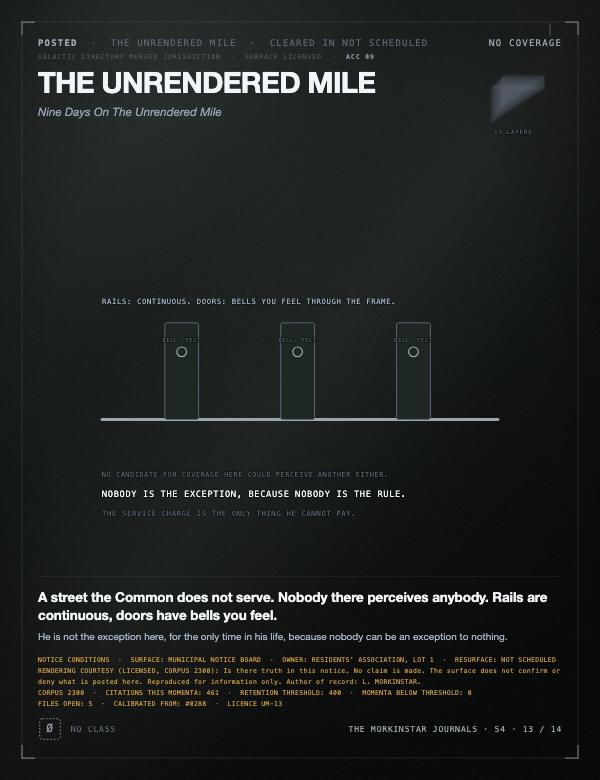
THE UNRENDERED MILE
Posted · clearance not scheduled
Greetings again, my dear readers.
I have had nine ticks on a street called the Unrendered Mile. It is not a mile and nobody who lives there calls it that. The long version is what it says on the coverage schedule, and a coverage schedule is a document about where a utility does not go, so the street is named after a gap in somebody else's paperwork, which I would find sadder if the rents were not the best in the city.
Here is the street, because that is the job.
It runs about four hundred paces, level, kerbed both sides, doors on the near side set two steps up, the backs of another block on the far side. There is no signage layer. I had got so used to walking through wayfinding that I had stopped seeing it, and then I came round the corner into a street where the graphics stop at the kerb like a tideline, and it took me longer to work out what was missing than I care to admit.
There is a rail. It starts at the first door and it does not stop, past every doorway at the same height, round the corner at the far end and back down the other side. It is the continuous handrail out of the citywide building code, and everybody on the Mile tells you the same thing about it, which is that a rail like that is what you want on a street where you cannot see anybody coming. They are right. I have leaned on it for nine ticks.
The doors have bells you do not hear. You press a plate on the frame and the frame moves, a small hard knock that carries through the jamb and into whatever is touching the floor in there. And every door has a brass lipped slot at ankle height, because that is how the Mile does its correspondence.
[Also posted- I have been pasting paper to walls in this city for a season and have had, at a generous estimate, four confirmed readers. Nine ticks on the Mile and I have had eleven replies, all in writing, all under a door, one a complaint about the way I fold.]
The Common does not come down this street, and I want to be flat about what that means, because it is not what a certain kind of reader is hoping for.
Nothing comes through. There is no truth under the utility. The people on the Mile are ten or eleven kinds of person who genuinely cannot perceive one another without a service standing in between, and where the service is not laid on they do not perceive one another at all. What is there instead is an absence, and around the absence a great deal of competent arrangement: the rail, the bells, the slots, everyone saying their own name first at a doorway and waiting. It is a street organised around a thing it does not have, the way you organise around a stair with no lift.
And nobody there wants coverage. Not one person I put it to in nine ticks, and not one of them gave me a reason that was about perception. They gave me a reason that was about the bill.
Which brings me to Ýrmund, who chairs the residents' association and has lived at number nine for forty years.
I met her the way everybody here meets everybody. I wrote a note and put it under her door and she wrote one and put it back under mine, and neither of us had to be an exception to anything. That is worth one sentence and I am giving it one sentence.
She sat me in her kitchen and put the kettle on and poured two, and put the second one down in front of me, and did not remark on it. It went cold there over two hours and she took it away at the end without comment, the way you clear a plate. I do not know whether she had worked out that I would not drink it or whether she simply pours two, and I did not ask, and a better correspondent would have.
She keeps the tribunal papers in a card folder on the dresser. Four decisions, and the one they lost is on top, on purpose, because that is the one you have to be able to find in a hurry. She finds a page by running the edge of her thumb down the stack until it catches, which is a skill she has and does not know she has.
They have fought the extension of coverage onto this street four times and they have won three, and she gave me the arithmetic of it in about six minutes without hesitating once.
Coverage is laid in cells. A cell is costed against the served addresses inside it, because the standing charge is billed to the address whether the address wants the service or not, so a cell only works if it holds enough addresses to carry the plant. An extension has to pass a served address density test, published, with a figure in it that is nobody's opinion. The Mile is a short street with doors down one side only, it sits at the end of its cell, and the parcel it would have to reach across to make the numbers work is the empty ground at the far end.
That ground is Lot 1, and I walked down and looked at it on my second morning. A rectangle behind a low kerb, drained, made up, with a paved way across the middle going from nothing to nothing, a street number on a plate at the corner, and four lamps. It has been empty since the city was laid out, because it is the first parcel that was laid out, and it is reserved.
The plate says so. It says LOT 1, and RESERVED, and then TERM: ONE ELYSHEIM, and then BYELAW 1, and nothing else.
A reserved parcel is not a served address and cannot be counted in a density test. It also cannot be released, because a release requires the term to expire or be surrendered, and there is no procedure for either against that term. So the test fails by one parcel, every time, and the one hearing the association lost it lost on notice periods and not on the ground.
(I know the word Elysheim from a table, where it sits with a realm beside it and a blank where the length goes. I am not going to make anything of that, my dear readers. I have made things of blanks before and it has never improved my week.)
So the Mile is cheap. It has a waiting list of two hundred and eleven, and the association publishes its own attrition rate every quarter, because Ýrmund's position is that a person on a list is owed the truth about what they are queueing for. The figure is thirty one per cent. A third of the people who reach the top do the trial stay and then decline the tenancy, because living with no coverage turns out to be a thing you can want very much and still not be able to do, and the bundle says in those words that there is no shame in it.
The other man is Guldri, who holds the maintenance contract on Lot 1 and has held it his whole working life.
He sweeps it. There is nobody on it to sweep for and he sweeps it, in a pattern, on a schedule, and he replaces the four lamps when they go. He has never once stepped over the kerb line, and I watched him work the edge of the ground with a long handled brush from the public side rather than take one step across.
He will not be interviewed, and I want to be fair to him, because he was not rude to me once. I asked him nine or ten questions over three days and every one came back as a clause. What is the ground for, and the contract says maintain, clear of vegetation and free of obstruction. Who reserved it, and the contract says the reserved parcel. I asked at last why he would not simply talk to me, and he said, without any edge at all, that the contract says maintain, and went back to the brush.
On the fourth evening one of the four lamps went. He came out with a new one and a step and did it in the dark with a hand light in his teeth, and when he had the old glass out he held it sideways without turning round, and I took it in both hands and stood holding a burnt lamp for four minutes, and when he wanted it back he put his hand out and I gave it to him with both hands, and neither of us said a word, and I have been in this job a long time and that was an interview.
Ýrmund told me about her partner on the seventh evening, without my asking.
He came here with her. He did the two years and then moved to a served address across the district, because he could not do it, and he is one of the thirty one per cent, and she says the number out loud when she tells it. He still visits, every week. And she said, in that order and with not one scrap of self pity in it, that she likes him better now than she did when he lived here.
Then she asked me whether that was a terrible thing to say, and did not wait, and got up and put the kettle on.
The association's hardship provision is capped at nine ticks per applicant per year, published in the same bundle as the attrition rate. Ýrmund applied it to me on the first morning without being asked and told me she had, so I have known the number since the beginning, which is the only decent way to be given nine of anything. The service charge is billed to a person and settled through an account, and an account here is held against a rendering. Nobody has to refuse me anything. It does not resolve, the way the gate does not resolve.
On my second day I wrote the bundle up. Not a correction, because there is nothing here to correct and the Mile does not want anything from me. The service charge, the density test and its figure, the four decisions with the one they lost first, the list, the attrition rate, in plain order, in a hand a person can read standing up. I posted it on the association's own board, which is not on the city resurfacing register, because the city does not resurface an address it does not serve. Ýrmund put a note under my door the next morning saying the list figure was a quarter out of date. She was right. I went and changed it.
It was still there on the ninth morning. Every word of it, dry, a little curled at the top, the panel under it bare.
So I stood and read the whole thing through, which I have not done once all season, and that includes the statutory small print at the foot that a posted notice is required to carry, which is my own sentence with a licence code under it, all the way to the last four words, on a street where there is nobody for it to be played to and nothing for it to fail to resolve.
I did not say anything.
The bottom corner had lifted. It always does, even here, even on a wall that nothing is ever going to come along and cover. I put my thumb on it and held it until it stayed.
Notice conditions
Surface: association notice board, head of the Mile. Owner: Unrendered Mile Residents' Association. This surface is not on the city resurfacing register.
Rendering courtesy, reproduced as the licence requires: Is there truth in their legend? No one knows. My aim is never to prove or disprove the tales I come across. Just to report them to you, my dear readers. · LIC D/26 · SRC CORPUS 2300
Corpus 2300 · citations this momenta: 461 · retention threshold: 400
momenta below threshold: 0
Files Open: 5