The Standing Charge · NOTICE 14 OF 14
The Corner That Lifts
2,098 words · about 10 min
Back to The Morkinstar Journals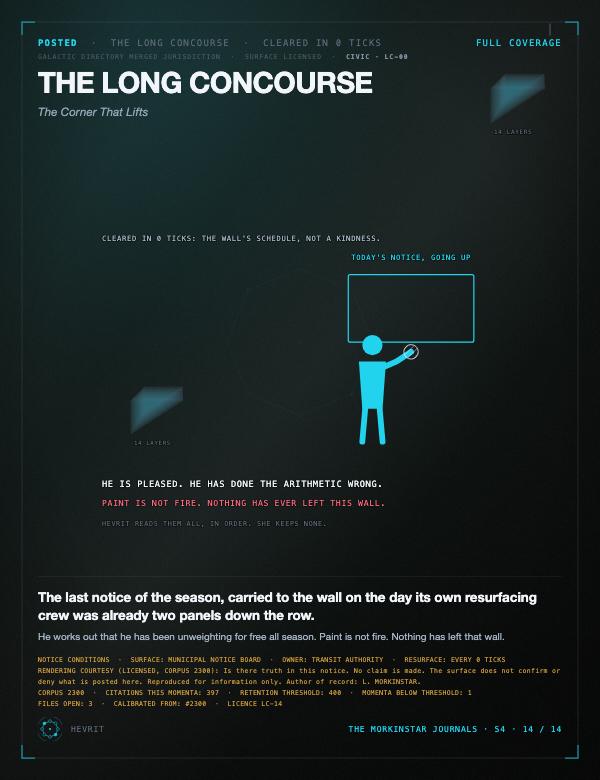
THE LONG CONCOURSE
Posted · cleared in 0 ticks
Greetings again, my dear readers.
I have come back to the Long Concourse, which was less a plan than an admission. Everything in this city that goes anywhere goes through this hall, and I have gone somewhere thirteen times since I last stood in it, and on every one of those thirteen crossings I walked the length of it with my head down and my paste drying in my bag.
Today I stopped in it twice, and both times were to read a sign, which tells you everything about what has happened to me here.
The first was the board.
You will remember the board. I mentioned it in the first thing I wrote in this city, on a small second sheet, in the tone of a man being charming about a piece of homework he has not done. It hangs at the head of the concourse at about twice the height of a door, it is roughly the size of a departures board, several hundred thousand people a day pass underneath it, and for three days I assumed it was departures. I said I kept meaning to go up close. Then I did not, for most of four momenta, and I am not going to construct a reason for that, because the honest one is that I was busy and the interesting one would be a lie.
It is in the city's own lettering, which is a very good lettering, kerned by somebody who cared. At the top it says FILES OPEN. Under that, in a figure about the height of my forearm, it says the number. Under that it says AS AT, and a time, and the time is recent. And under that there is a line about a third the size of the rest giving the byelaw the display is maintained under and the office that maintains it, and that line is the only part of the whole fixture anybody would ever have to check.
The number is three.
Nobody looked at it. I stood underneath it for a long while and watched people come up out of the platforms and go past and around me, and not one person raised their eyes to it, and I want to be careful here, because that is not apathy and it is not a sad fact about a crowd. A file being open somewhere in a merged jurisdiction is not news to a person carrying a bag. It is a maintenance figure. It is the same class of object as the load rating on a floor, which nobody reads either, and which nobody needs to read, because the building is standing up.
I went to the service window and asked what happens when it says nothing.
The duty officer today was Nœvik, who explained gate fourteen to me on my first week here and who did not appear to find it remarkable that I was back. He said it does not say nothing. It says zero. Then he told me the rest of it in about four minutes, without hesitating, and he was right, and none of it is a secret, because none of it ever is.
The fixture stays. The power stays, because taking a fixture down costs more than leaving it up and a dark display at that height is a hazard notice waiting to happen. The surface is an asset, and an asset in that position with that footfall is a valuable one, so there is a contract for it, and the contract has been executed and filed and is in the published register with everything else. It does not carry a commencement date. It carries a commencement condition.
The condition is zero.
I asked whether anybody was waiting for it. He said no, and he said it in the mildly puzzled way of a man being asked whether anybody is waiting for a fire door to be needed. Nothing is scheduled. Nobody has a target. The board goes up as easily as it goes down, and it went up three districts ago because somebody wrote something down, and it will go up again the first time anybody reports a thing this city has no field for. The contract is simply correctly filed against a number, and the number is free to move.
[Also posted- I brought two sheets today. I had got out of the habit somewhere around the Rows, in the way you get out of habits, which is not by deciding anything. Then this morning I cut a second one without thinking about it and only noticed at the wall. So you are getting this, and I am not going to make a thing of it, and I would like it on the record that I cut it slightly crooked.]
On the way down the hall I went and stood at the far left of the gate line for most of a shift, because I wanted to see.
Gate fourteen did not open for anybody. It sat there, doing the ordinary work of a gate, twenty two of twenty two, entirely uninteresting. The boundary got moved. It went to the office that owns boundaries rather than to the office that owns gates, and somebody there did the work, and then somebody else certified it, and then the last field on the file got filled, and it came off that board a long way back while I was three districts away being rained on indoors.
I wrote that notice. It was read. It is the best thing I have written in a very long time and it has been gone off this wall since the first cycle after I put it there, and it worked anyway, and I have decided to let both of those be true at once.
The wall is halfway down the hall on the left, and when I got to it the crew were already two panels along the row, working toward me.
There are two of them on this stretch and one of them is Hevrit, on the low trolley, with the roller on the pole and the bucket hooked over the back of one wrist, on that same knuckle, worn pale and smooth. She has been on this route longer than I have been in the city. Sixteen panels: the four before this one, this one, the eleven after it.
She saw the sheet and told me straight away that today was the day, in case I had not looked at the bar, which I had. Forty ticks, and the forty ticks were up. Then she asked if I still wanted it up, and she asked it the way you ask a man whether he wants the window open, with no weight on it whatsoever, and I said yes, and she said right, and got the paste.
Then she went over the panel with the flat of her hand before I put anything on it. The whole face, corner to corner, twice, the way you would smooth a bed you were not going to sleep in. I asked what she was checking for. She said grit. She said if there is grit under it the paper tears when it comes off and then it comes off in two goes instead of one, and two goes is two goes.
I asked her what she does with them.
She said she reads them.
I asked her if she meant that in the way people mean it, which is that they see the top line on the way past. She said no. She said the primer has a flash off time of nine minutes and there is nothing to do in nine minutes, and there is a wall in front of her, and she has been standing in front of it for years, so she reads them. All of them. In the order she comes to them, which is the order of the route, which is not the order they went up, and she said that as a small professional annoyance rather than as anything else.
I asked her if she keeps any.
She said no. That is not the job.
While she was cutting in the next panel I read the licence bar along the bottom of the row, which carries the resurface record, panel by panel, date by date, because the record is what makes the schedule auditable. Forty, forty, forty, forty, all the way along in a neat column.
One of them is eighty.
I asked her about it. She said a panel goes round twice sometimes. That is all she said, and she said it while she was working, and she did not stop working, and I did not ask her a second time, because I have spent my whole career being the man who asks a second time and I have learned, slowly and expensively, that there is a kind of answer that is complete.
I do not know which panel it was. The record gives the panel and the date and not what was on it, and this is a route of sixteen surfaces in a hall that several hundred thousand people cross in a day, and half this city puts things on walls. It was almost certainly not mine. I am telling you about it because I read it and because I am not going to sit here and guess in front of you.
And here is what I worked out while I stood there with the brush, my dear readers, and I would like to be allowed to be pleased about it.
Fourteen things. Fourteen sheets, thirteen walls, because I have come back to this one, and I kept no copies of any of them, and they have come off on their own schedules without my doing anything at all. Forty ticks here. Ninety in Eleven Hold, which is a poor district and waits for a roller. A hundred and twenty at the Gauge. Four hundred in a listed corridor by a different department who are apparently very good. One address on the whole route is not scheduled, and I will grant you that one, and one out of fourteen is a rate I would take from any service anywhere. Not one of them cost me a thing. It is somebody's shift and somebody's route and the city calls it maintenance and puts it in the accounts under surfaces.
I have watched a people spend a whole generation preparing to do this. I have watched them give away everything they own and everything they have written down, every ninth generation, on the reasoning that a thing survives by periodically becoming light, and I have watched what it takes out of a person to actually do it, and I paid that price myself, once, and I will not be doing it again.
And it turns out that a two person crew does it here on a rolling programme with a roller on a pole and a flash off time of nine minutes.
I have not felt this light in a very long time.
The paper went on well. The edges of these panels are thick, by the way, thicker than a panel has any business being, and at the top corner of this one the build up has cracked back and there is a strip of something old showing underneath in a lettering the city stopped using, three or four words of it, still perfectly legible. I looked at it for a while. It is the sort of thing you get on any old surface and it is nice, in the way that is nice.
Then the primer came down the row and reached the panel next to mine, and Hevrit set up on it, and there were nine minutes with nothing in them, so the two of us stood in front of a wall and did not say very much.
The bottom corner had lifted while I was talking. I put my thumb on it and pressed it back down.
Notice conditions
Surface: Long Concourse notice panel 6. Owner: City. This surface is resurfaced every 40 ticks.
Rendering courtesy, reproduced as the licence requires: Is there truth in their legend? No one knows. My aim is never to prove or disprove the tales I come across. Just to report them to you, my dear readers. · LIC D/26 · SRC CORPUS 2300
Corpus 2300 · citations this momenta: 397 · retention threshold: 400
momenta below threshold: 1
Files Open: 3