The Standing Charge · NOTICE 2 OF 14
The Fourth Riser
1,944 words · about 9 min
Back to The Morkinstar Journals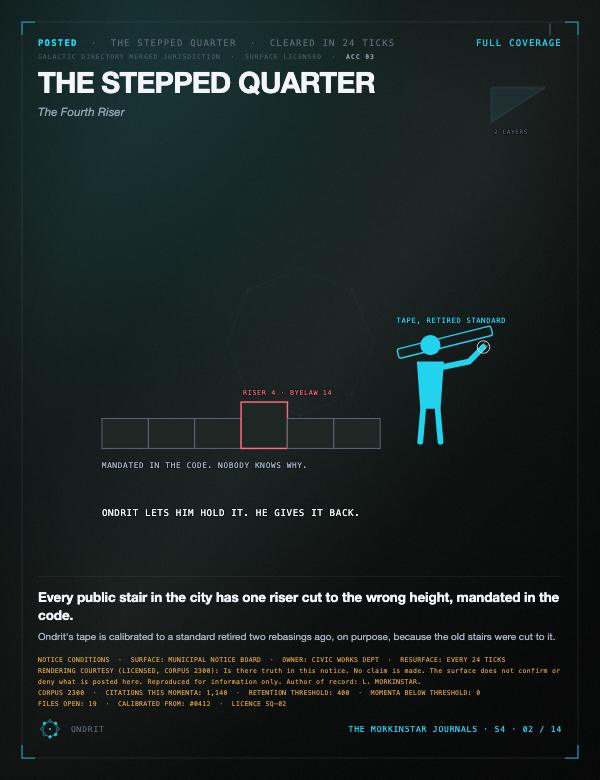
THE STEPPED QUARTER
Posted · cleared in 24 ticks
Greetings again, my dear readers.
I have come up out of the concourse and along and up again into a district that is very nearly all stairs, and I want to begin with the sound of the place, because the sound is the entry and the rest of this is me explaining a sound.
Stand at the top of any public flight here and listen for a minute. Every few seconds somebody catches themselves. It is not a fall and nobody treats it as one. It is that small hitch a person makes when a foot lands lower than the foot was expecting, the quick correction through the hip, a hand going out to the rail and coming back. A woman coming up with a stacked tray does it without breaking her sentence. Two people carrying a rolled floor covering between them do it one after the other, on the same tread, in the same way, and neither of them mentions it, because there is nothing to mention. It happens at the fourth riser from the top. It happens on every public stair in this city. It is in the code.
(I did it too, of course, first flight, second minute, hand out, and the rail I grabbed did not stop where a rail is supposed to stop. Rails here do not stop. They run on round the turn and down the next flight and keep going, and I am told they are like that citywide, and not one person I have asked has any idea why. So that was my first ten minutes in the Stepped Quarter: you cannot trust the stairs and you can trust the rail absolutely.)
Byelaw 14, schedule 2. On any public flight of five treads or more, the fourth riser from the top is cut short of the others by a stated amount. Not approximately. There is a figure, there is a tolerance either side of it, and there is a form.
The district is proud of this. I want to be very clear that I am not being arch. There is a heritage plate at the head of the west flight, brushed metal, properly installed, at a height a great many different kinds of person can read, and it says that the short riser was granted at the merge as an accommodation to a founding people whose descent gait counts in fours, and that it was bought with a concession on something larger, and it does not say what the larger thing was. Then it gives the accession number and stops. The people it was granted for are not in the city any more. The accommodation is.
[Also posted- the resident association here publishes a monthly figure for stair injuries and it has fallen every year for longer than the association has kept minutes, and the reason it has fallen is that everybody who lives here learned to walk here. It is the visitors. It is always the visitors. I am the visitors.]
I went to find somebody who measures them, which is how I met Ondrit, who has been certifying public stairs in this district and four adjoining ones for most of her working life, and who told me the number without rounding it. Thirty nine thousand, four hundred and something. She apologised for the something. She is in the middle of a cycle and she does not like to quote a figure she has not closed.
She carries two tapes.
The first one is the issued tape, sealed, on a lanyard, with a current calibration label on the case and a certification number that matches the one on her paperwork. That is the tape that goes on the form. The second one lives in a pocket and comes out more, and it is a spring drum in a brass case worn shiny in the two places she holds it, and its label names a standard that was retired two rebasings ago. She keeps it calibrated to that standard on purpose. She has it recalibrated, at her own cost, by somebody who still has the reference, and when I asked why she looked at me the way you look at a person who has asked why you own a spoon.
Because the old stairs were cut to it, she said. If you take a current tape to a stair that was cut before the rebasing you get a number that is wrong in a way that is nobody's fault and tells you nothing. So you take the tape the stair was cut with, and then the stair answers you.
She works kneeling, one hand laid flat on the nosing, thumb hooked over the lip, and she does not look at the tread while she measures it. She looks somewhere along the flight, middle distance, the way you look at nothing while you listen to something. I asked, later, and she said she has never been able to measure and watch at the same time and stopped trying about thirty thousand stairs ago.
She put the end of the tape into my hand and asked me to hold it on the lip while she walked the drum down, which she did without any preamble and without asking me anything about myself, and I would like to record that she is one of a small number of people in this city who has had to work out on the spot how to deal with somebody the Common does not resolve, and that she did it by handing me one end of a tape. I do not think it cost her a thought. She spends her working life measuring things she is not looking at.
The short riser, in her hands, took about six minutes to explain from end to end and she did not hesitate once.
The dimension is mandated, so a stair that has it is compliant and a stair that does not is not. That is the whole of it legally. She certifies to the code and the code says short, and a flight she has to fail is nearly always a flight where somebody has helpfully resurfaced a landing and brought the fourth riser back up level with the rest, which is the single most common defect in the district and is committed entirely by people trying to be kind. There is a variance procedure for the whole byelaw. It has been submitted twice. It was refused both times, and Ondrit thinks both refusals were right, and she can show you why: varying it means recertifying every public stair in the jurisdiction, and the recertification cost is a number she has actually seen, and the saving is fewer bruised hands, and the saving does not exceed the cost. She said this without heat. She was not defending anybody. She was telling me what the arithmetic says, the way she would tell me what a tread measures.
[Also posted- there is a shop on the second landing that sells nothing but footwear with a reinforced toe box and it is comfortably the most successful business on the west flight. I asked the man at the counter whether he found that funny. He said it was seasonal.]
And then, because I asked her whether the code got it right, she told me about the old ones.
She keeps a notebook. Not an official one, her own, and in the back of it there is a list of flights in this district and the adjoining four that predate byelaw 14, and predate it by a very long way, and predate the merge itself. Founding fabric, brought up or built up before there was a shared code to build to, by people out of unconnected traditions who had never seen each other's work and could not have described it to one another if they had.
She has measured all of them with the old tape.
They are all short at the fourth.
I asked her if she was certain. She said she was certain because she had gone back and done the twenty two of them a second time on a different cycle with a different assistant writing the figures down, and then a third time on the ones where the nosing was worn enough to argue about. Twenty two flights. Four building traditions that shared nothing. One measurement, and the same one.
The byelaw is not why the riser is short, my dear readers. The byelaw is a description. Somebody at the merge went and looked at what stairs were, and wrote down what they found, and the thing they found was already there, in unrelated stone, on flights cut by people who had never met.
I recognised the shape of that immediately and I want to be honest with you about what I did with it, which is nothing.
I have met this before. A thing that is true on worlds that never touched each other, in the same form, to the same figure, with no route between them and nobody able to say where it came from. I found one of those a long time ago and I wrote it down and I did nothing about it, and then I wrote it down again, and again, and I went on doing that for fifty five entries and I still cannot tell you a single thing about why. So I am not going to stand at the top of a flight of stairs and pretend this one is different. It is the same shape. I have no more to offer it than I had then.
But I did ask Ondrit whether she had ever reported it.
She asked me, reasonably, reported as what.
So we went and looked at the form, which is a good form, clear, four sides, and it has a field for non compliant features with a printed list of permitted values, nine of them, and you tick one. Cracked nosing. Rail discontinuity. Riser irregularity, unmandated. Riser irregularity, mandated. And on down. There is no value for the stair was already like that before anybody wrote the rule and I do not know why, and there is no free text box, because a free text box in a certification form is an unbounded value, and an unbounded value has nowhere to land.
Ondrit said, with no bitterness whatsoever, that a form is for what the form is for. Then she stood up, went and did the next flight, and let me hold the end of the tape again.
The compliance plate at the head of that flight, since I am going to read a wall out to you the way I read a legend out to you, says: PUBLIC STAIR. CERTIFIED. BYELAW 14, SCHEDULE 2. RISER IRREGULARITY, MANDATED. Then a dimension source line with a corpus citation on it. Then ACCESSION 03 on its own, and nothing after that at all.
And the only part of it I want to talk about is the word CERTIFIED, which is doing a great deal of work on a stair that is wrong on purpose, and which is, I am told, exactly correct.
She let me hold the old tape at the end, out of its case, the whole drum, so I could feel how much of it there is. I gave it back with both hands.
I am pasting this up at the third landing, on the panel, beside the shoe shop, at the height they put things here.
The bottom corner lifted. It always does. I pressed it down.
Notice conditions
- Surface: civic notice panel, third landing, west flight, THE STEPPED QUARTER. Owner: City. Resurfaced every 24 ticks.
- Rendering courtesy, reproduced as the licence requires: Is there truth in their legend? No one knows. My aim is never to prove or disprove the tales I come across. Just to report them to you, my dear readers. · LIC D/26 · SRC CORPUS 2300
- Corpus 2300 · citations this momenta: 1,140 · retention threshold: 400
- momenta below threshold: 0
- Files Open: 19