The Standing Charge · NOTICE 10 OF 14
Every Sentence Where He Was Not Sure
2,103 words · about 10 min
Back to The Morkinstar Journals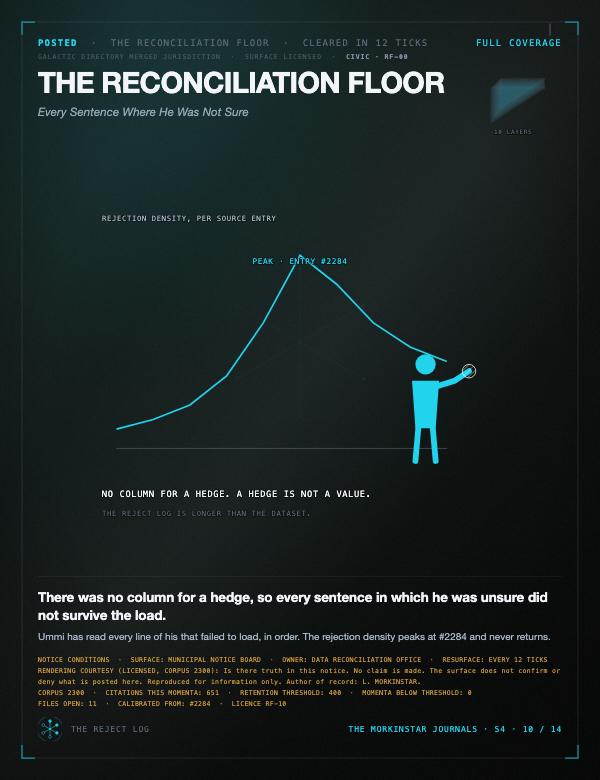
THE RECONCILIATION FLOOR
Posted · cleared in 12 ticks
Greetings again, my dear readers.
The Reconciliation Floor is a floor. I came down expecting a department and what there is, is a level: one storey of a services block, very long, warm all the way through from whatever is running underneath it, and quiet in the particular way of a room where the actual work is being done somewhere else by something else and everybody present is checking up on it.
They work in shirtsleeves. There is a rail down the middle of the main aisle, continuous, running the whole length of the floor and out through the far doors and off up a corridor that has nothing whatever to do with this floor, and I have stopped remarking on the rails, and I have not stopped leaning on them.
The plate at the head of the stair says THE RECONCILIATION FLOOR in the city's own lettering, cyan, correctly kerned, professionally installed, at the height a sign goes on a wall. Under it, CIVIC PARCEL 019. Under that, LOAD RECORDS RETAINED UNDER BYELAW 61. And then, as ever, the end of the sentence.
[Also posted- there is no accession number on that plate. The districts that came from somewhere carry one in the same slot, and I have got into the habit of checking that slot on every sign I walk past, which tells you a good deal about how I have been spending my evenings. This floor did not come from anywhere. It is just the city. So the slot has a parcel code in it instead, and a parcel code is the city saying, politely, that nobody founded this.]
Here is what the floor is for, and it took me a day to get it into a shape I could put on paper.
When the merged jurisdiction bought the corpora, it did not read them. Reading is not an operation you can run on a purchase that size. What it did was load them, which is a different thing entirely and I did not understand the difference until this week. The standard has columns. Doorway width has a column. Reach, resting temperature. Self term has a column, and I have been quietly proud of that one for as long as I have known it exists. Every sentence in every corpus had to arrive in one of those columns, or it did not arrive.
Mine is two thousand three hundred entries of a man talking.
The floor maintains the loader that does it. Not did it, does it: the load is re-run every time the target changes shape, which is often, because forms change and columns get added and a merged jurisdiction is never finished tidying. Each time, it runs from the source again, from the top, all of it. They have been doing that here for a very long time.
Before I get to the person, the aisle, because I paced it.
The reject aisle is longer than the floor it is on.
The level has a certificate and the certificate gives a length. I walked the aisle twice, out and back, at a pace I have been calibrating against door widths since before some of you were reading me, and I made it comfortably longer than the level it sits in. So I went and said so to somebody, which is the job.
The somebody is Marvek, who maintains the loader, and who took me to the aisle plate and put his hand under the small print. There is a dimensional variance on file. Granted, signed, referenced by number on the plate, and the reason field on it is one line long: SEQUENCE UNBROKEN. The reject log prints on continuous stationery and has never been cut, anywhere, since the first load, because cutting it would break the sequence and the sequence is the record. A length that will not be cut has to go somewhere, and the variance is where it goes. Two people walked past me while I was pacing and one of them stepped round me without looking up.
Then Marvek explained the load. It took him about six minutes, he did not hesitate anywhere in it, and when I asked him to go back over the middle he went back over the middle.
A load is a sentence at a time. The loader takes a sentence, works out what it is asserting, and puts the assertion in the column it belongs to. A measurement goes in. A self term goes in. A name, a count. Anything with a value in it goes in, and the great majority of my working life turns out to be things with values in them, which was a nicer feeling than I expected and lasted about a minute.
And a hedge is not a value.
That is his sentence, not mine, and he said it without any weight on it at all, because to him it is simply true, in the way that a door is a door. I think, probably, the rig is not confident here, she may have been joking and I have decided to take it seriously, I do not know why: none of those are values. They are not wrong values. They are not out of range. There is nowhere for them to land, and a loader is not permitted to guess, and quite right too, because a loader that guesses is a loader that fabricates and then a whole galaxy is built on a guess.
So the loader logs the line and moves on.
There are seven reject codes. Marvek printed me the list and it is a good list. Four of them are formatting. One is a value outside a permitted range. One is a duplicate. And the seventh, which is the one that does nearly all of the work on my corpus, reads NO TARGET COLUMN.
I want to be fair to that. My first instinct was to be witty and my second instinct was better. The code is accurate. No field is missing and nobody left anything out. The system looked at a sentence I wrote when I was not sure, and recorded, correctly, in three words, exactly what was the matter with it, and then kept the sentence, because the log is retained under byelaw 61, forever, at full length, uncut.
The reject log is longer than the dataset.
I asked whether that was normal. Marvek said it depends entirely on the source, that a survey report loads almost clean because a survey report is nothing but values, and that mine is at the other end and has been since the first run. He said it the way a man tells you which way the wind usually comes from. He was not commiserating and I did not want him to.
[Also posted- I asked what happens to a rejected sentence on the next re-run. He said the same thing happens to it. Every time. Rejected, logged, printed again, same place in the sequence, new paper. I started working out how many times my parentheticals have now been declined by a competent machine and then I stopped working it out.]
The person who keeps the log is called Ummi.
She is a reconciliation clerk and she has the reject aisle, which means she has my entire hedging career, in order, from the first line of the first load to whatever came off the printer this morning. She works standing and walking, because that is how you read a thing that has not been cut. She keeps her place with the flat of her hand on the fold, and she flattens each new fold with three strokes, the same three, and the outer edge of that hand is worn to a soft grey shine from doing it, the way the knuckle of a woman I know four districts away is worn pale from a bucket handle.
When she wanted me to read something she did not point at it. She turned the whole fold toward me and put her hand down flat beside the line, well clear of it, so that nothing of hers was on top of anything of mine.
Then she read me a stretch of it out loud, standing in the aisle, in a flat clerk's voice, because I asked her to and because she has an excellent reading voice and no opinion about it.
I could not have told you which entry any of them came from. I could not have told you the world. I did not recognise a single sentence and I recognised the man saying them immediately, which is a thing I do not know how to write down properly and have now tried four times.
She has read all of it. In order. And nothing else of mine at all, ever, because the loaded side is not her side of the floor and she has never had a reason to go over there. Two thousand three hundred entries, my dear readers, and the most careful reader my work has ever had has read only the parts of it that failed.
She has noticed something, and she brought it up before I had worked out how to ask her anything.
She keeps her own figures on rejection density per source entry, which is not part of the job, and it is a curve. It climbs gently across the early entries the way you would expect of a man getting older and less certain. Then at one entry it goes up sharply and never comes back down. Not in the entry after, not in the ten after that, not ever.
She named the entry without being prompted. Twenty two eighty four.
And she said the part that got me, which is that the same entry has fewer parentheticals in it than the ones on either side. Fewer jokes, more hedges. She said she had assumed for years that those two things moved together and on that entry they did not, and she asked me, straightforwardly, with no particular expression that I could read, what happened there.
I told her the truth as far as I am able to tell it. I said that on that world I was told something I decided not to write down, and that I have never been certain that was the right decision, and that everything I wrote afterwards was written by a man who had left something out and knew it.
She did not ask what it was. She said that would be in the log if it were anywhere, and it is not in the log, and she would know.
Then she told me about the note.
She files one every year. It says that the reject log contains material which has no representation in the loaded dataset, and it gives the volume, and it recommends that this be recorded as a known limitation of the source. It goes up. It is acknowledged. It has been acknowledged every year she has filed it, promptly and courteously and in correct form, and she does not expect anything else to happen, and she files it anyway, because it is true and filing true things is the job.
I did not say the thing I wanted to say to her. I want that on the record.
At the end of the counter row there is a small repeater panel, the same lettering as everything else, no bigger than a form, giving the citywide Files Open figure. Nobody on that floor looks at it. While I was standing there it went from twelve to eleven.
I asked what had closed. Ummi went and looked it up without any fuss, because it is published, and read it out: a structures file in the Stepped Quarter, riser irregularity, closed on receipt of a measured value from a competent source. Status: no items outstanding. Source of measurement: Ondrit, spelled correctly, with a calibration standard after it that was retired two rebasings ago.
I was pleased. I stood in a warm room being pleased for a woman with an old tape, and Halkri was right, and a stair somebody can put a foot on is worth a sheet of paper.
Nothing is outstanding on that stair now.
I pasted this on the panel by the goods lift, where the floor's own notices go, at the height they put things here. Ummi came down the aisle to the end of the fold and stopped, which is as far as she goes.
The bottom corner lifted. It always does. I pressed it down and held it while the paste took.
Notice conditions
Surface: notice panel, goods lift lobby, THE RECONCILIATION FLOOR. Owner: City. This panel is resurfaced every 12 ticks.
Rendering courtesy, reproduced as the licence requires: Is there truth in their legend? No one knows. My aim is never to prove or disprove the tales I come across. Just to report them to you, my dear readers. · LIC D/26 · SRC CORPUS 2300
Corpus 2300 · citations this momenta: 651 · retention threshold: 400
momenta below threshold: 0
Files Open: 11