The Standing Charge · NOTICE 9 OF 14
The Levy With No Instrument
2,185 words · about 10 min
Back to The Morkinstar Journals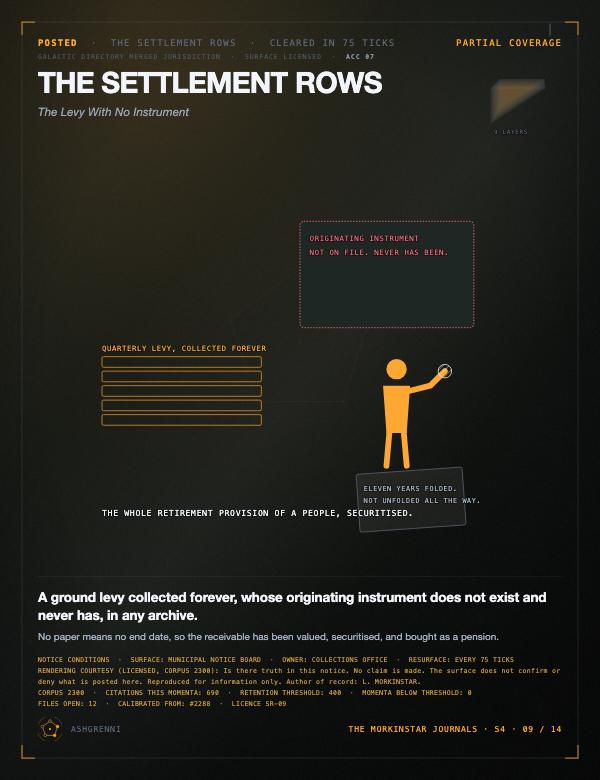
THE SETTLEMENT ROWS
Posted · cleared in 75 ticks
Greetings again, my dear readers.
I have been on the Settlement Rows for most of a momenta and I have not yet managed to find the front of anything.
The Rows are eleven runs of low dwellings laid out parallel, long enough that from one end you cannot make out the other, in that thick sodium orange municipal lighting goes when a district is on partial coverage. Every dwelling has a door at the front and a door at the back and the two are in line, so a run is not a street with houses along it, it is a run with rooms threaded onto it. There are no thresholds. The floor of a dwelling is the floor of the run carrying on, flush, no step and no lip, and the way you know you have gone indoors is that the light changes and the sound of your own feet changes. For three days I kept apologising to people whose kitchens I had walked into. On the fourth day I noticed that not one of them had told me I was in a kitchen.
The numbers are in the ground. Not on the doors: cut into the paving in front of each door, filled with something pale, worn shallow where people cross them. The demands come addressed to the number in the ground. I asked a woman scrubbing hers with a brush why the number was down there and she said because that is where it is.
The signage at the head of run one says TO THE SETTLEMENT ROWS. Under it: GROUND LEVY, QUARTER DAYS AS PUBLISHED. Under that, DWELLINGS HELD UNDER LICENCE CLASS P/07. And on the wall of the collections office at the end of run four there is a plaque, at signage scale, correctly installed, that says ACCESSION 07 and absolutely nothing else.
[Also posted- coverage here is partial, which means the Common bands and strains and resolves people toward whatever it has most of, and everybody deals with it the way you deal with a lift that is slow. The collections counter keeps a slate and a chalk and a bell on a string for when it drops out mid sentence. Nobody has ever suggested to me that this is a hardship. It is a thing about the address, like the drains.]
Now. The levy.
Every quarter, every dwelling on the Rows pays a ground levy. It is charged per measure of ground, so the ground has to be measured, so on the morning of the quarter day a surveyor comes and measures it.
His name is Immek and he walks the eleven runs with a chain and a satchel of brass pins, and he was happy to have me alongside for two of them provided I did not stand on the chain, which I did twice. He lays, he pins, he reads, he writes the figure in a book, and the book goes to the office and the demands are raised off the figure.
The figure is different every quarter.
Not by much. It moves the way a thing moves when it is measured properly by somebody careful, and it does not move in one direction, it moves both, and it has never gone outside the tolerance printed on his certificate except twice in the nineteen clicks he has been walking it, and both times there was a form, and he filled it in, and it was accepted. The households know what the variance runs to and they budget for it. The office publishes the figure on the counter door the same afternoon.
I asked him, because I am me, whether it was not odd that the ground did not come out the same twice.
He said the tolerance is published.
I asked whether he had ever wondered about it.
He said he measures on the quarter day, and that if I wanted the tolerance explained I should ask at the office, because they have it printed and they are better at it than he is, and then he unhooked a pin with two fingers and put it in the satchel and walked on. He was not being short with me. He was seventy measures behind where he wanted to be, and I was standing on his chain.
So I went to the office, which is where I should have started, and that is where I met Rœst.
Rœst is the collections administrator for the Rows and has been for eleven years, and she raises fourteen thousand demands off Immek's figure every quarter and then answers for every one of them at a counter. She has a thimble on one digit for counting sheets, worn through at the tip. She has worn out four of them and keeps the dead ones in the drawer, because a new one grips too well and tears the carbon on the third copy. She showed me the dead ones. She has them in order.
She took me through the whole thing in about six minutes without hesitating anywhere, and when I asked her to go back over the middle part she went back over the middle part and did not make me feel like a slow child about it.
At the merge, the people who were here made a settlement. They gave up their claim on the ground, which the incoming jurisdiction wanted registered in a form they had never held it in, and in exchange they took a perpetual levy on it. Perpetual because that was the deal: not for a term, not until a sum, forever, on the ground, quarter by quarter. It was, Rœst said, with no editorial in her voice at all, a very bad deal, made by people who had every reason to think it was a good one, in a hurry, on the schedule of a merge that was running eleven days late.
Four thousand clicks of quarter days later, the levy is still collected. The people who live on the Rows now are not the people who made the settlement, they are anybody, mostly small households, mostly poor, and they pay it because it is on the demand and it is correct.
And the money goes to a fund.
A stream of income that never stops is worth something. It was valued, correctly, by competent people, and sold in units, correctly, to the fund that holds it now, and that fund is the entire retirement provision of the Ashgrenni, who are the people who took the settlement. Every pension on their books is that levy. There is no other asset in it. There has never needed to be, because the thing pays every quarter and it does not have an end date.
I asked why it does not have an end date.
And here is where Rœst put both hands flat on the counter.
The instrument does not exist.
Not lost. Not sealed, not restricted, not in a stack somewhere with a retrieval charge on it. There is no originating instrument for the ground levy on the Settlement Rows, there is no record that there ever was one, and every archive that could hold it has been searched, twice by the fund's own people and once by the district. The searches are on file and I have read them and they are thorough. What exists is the practice: an unbroken run of demands raised and paid, four thousand clicks of them, each one perfectly correct, each one citing the settlement, and the settlement citing nothing.
So there is no end date, because an end date is a thing that lives on a document. And because there is no end date the receivable can be valued as perpetual, and because it is valued as perpetual it was worth what it was worth, and because it was worth that a species bought its old age with it.
The day somebody says out loud, in a form, in the right office, that there is no instrument, the levy stops. Fourteen thousand of the poorest households in this district stop paying a quarterly charge they cannot really afford on ground they do not own. And the fund's only asset goes to nothing, and every Ashgrenni pension in payment stops, and I have seen the note on that, because Rœst showed me.
She keeps her own working of it on one sheet, folded in eights, in the pocket at her hip, and it has been in that pocket for eleven years, and the creases have gone soft and furry the way paper does. She did not describe it to me. She took it out and opened it on the counter as far as the second fold and no further, and held it there with two fingers on the top edge and her thumb keeping the bottom third under, and turned it round so I could read the part she was showing me, which was a column of years and a column of counts.
She has modelled it properly. She is not guessing and she is not catastrophising. It is nine hundred and some households at the other end of it, and she has them by age band, and she has the year the last one dies in, and it is a long way off, and it is the number she was showing me with her thumb on the rest.
Then she asked me not to post it.
She asked directly, which I want on the record, because people almost never do. She did not appeal to anything. She did not tell me it was complicated, or that I did not understand the district, or that it was not my business, all three of which were available to her and two of which were true. She said: I know what you do, and I am asking you not to write this one. And then she said the thing that finished it, which was that she has not said it herself in eleven years and has had eleven years to work out whether that makes her a coward, and has not settled it, and does not expect to.
I said I would think about it.
I thought about it for two days on a district where the ground does not measure the same twice, and then I went back and told her I would leave it out.
I want to be plain with you about what that is, my dear readers, because you have a right to it.
I have held something back three times before. Every one of those, the cost landed on me. This one does not cost me anything at all. It costs fourteen thousand households a charge they will keep paying, or it costs nine hundred old people the only thing they have, and the whole of the choosing happened inside my own head in a room that neither set of them has ever been in. I do not have a defence for it. I am not offering one. I picked, and the way I picked was that Rœst asked me and I could see her hands, and if you want that to be a worse reason than the arithmetic then I am not going to argue with you.
[Also posted- I once wrote up a debt that ran forever because the paper burned. This is not that. Here the paper never existed, and I have made a note of the difference so that neither of us mistakes one for the other, and that is all I am doing with it.]
So I wrote up something else, and it is true, and it is small, and it is worth having.
The demand carries a period for objection that ends on the quarter day. The demands are printed in one batch and delivered along the runs on foot, by one person, over eleven days. So if you live at the top of run one you have your full period, and if you live at the far end of run eleven you have three days of it, and nobody has ever written that down. The office will extend it. There is a form, and the form has a field for the delivery date, and Rœst told me herself, at the counter, that she grants every one she gets and gets about four a quarter.
So my notice says which office, which form, which field, and that you should write the day the paper came through your run on the back of it, and it says at the bottom, in the plainest words I could find, that they will say yes.
I pasted it on the panel outside the collections office, which is resurfaced every seventy five ticks, so somebody will come along with a roller about two quarter days from now.
The bottom corner lifted while I was still standing there. It always does. I pressed it back down with the flat of my thumb and held it until the paste took.
Notice conditions
Surface owner: Settlement Rows District Board. This panel is resurfaced every 75 ticks.
Rendering courtesy, reproduced as the licence requires: Is there truth in their legend? No one knows. My aim is never to prove or disprove the tales I come across. Just to report them to you, my dear readers. · LIC D/26 · SRC CORPUS 2300
Corpus 2300 · citations this momenta: 690 · retention threshold: 400
momenta below threshold: 0
Files Open: 12