The Ninety-One Pages · PAGE 4 OF 91 · Vœrhan
The Weather They Made Up
2,048 words · about 9 min
Back to The Morkinstar Journals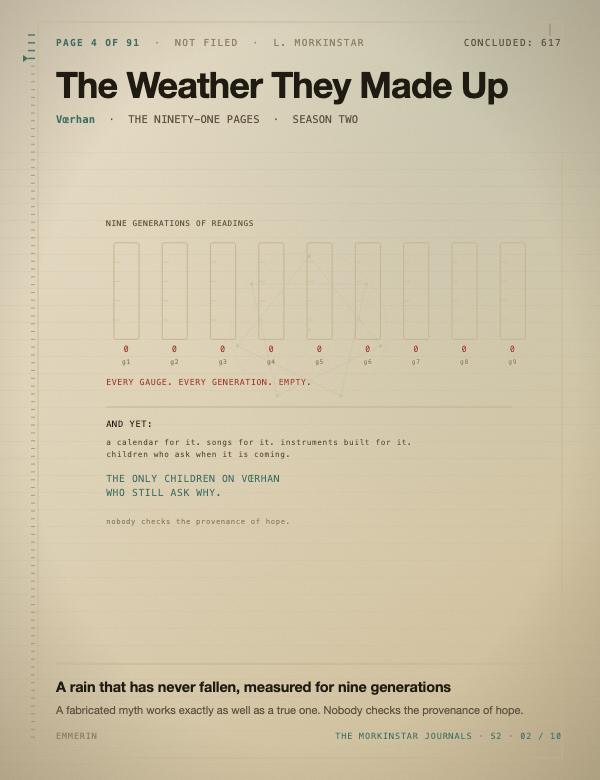
Page 4 of 91
Page four, my dear readers, and I want to say up front that this one is not going in as evidence of anything. I built this case to hold things nobody has written down before, and what I found on Vœrhan is not new in the sense the Directory would recognise. Nobody discovered a phenomenon. Nothing measured against anything. I am putting it in anyway, and by the end of the page I hope you will see why I could not leave it out.
Vœrhan was Concluded forty galaxals ago. I want to be precise about what that means because I am starting to suspect most people, myself included until recently, hear the word and picture something closer to abandoned. It is not abandoned. It is the opposite of abandoned. A Concluded world is one the Directory has finished with because there is nothing left to finish. Vœrhan's air is good. Its harvests come in on schedule. Nobody there is sick in any way that matters, nobody starves, nobody fights anybody else over land or water or the eleven other things species usually fight over once the first three stop being scarce. The self term is Hessin, which the rig renders, and I checked this rendering four separate ways because I did not believe it the first time, as "those who are expecting it."
That is a strange thing for a species to call itself when you consider that, by every account I could get, there is nothing left on Vœrhan that anybody is expecting. The harvest comes when the harvest comes. The seasons turn the way they have turned for longer than anyone keeps count of. There are no gods on Vœrhan and no monsters either, in case you were bracing for the fourteens, because there is nothing there for a myth to explain any more. It got explained. All of it. A long time ago, thoroughly, by people who were apparently very good at their jobs, and what was left afterward was a species that is healthy and fine and, and I want to choose this word with some care because I do not mean it unkindly, incurious. I have met this before. I told you about it at the world with no number, the one I am not going to name here either out of a promise I made myself that I intend to keep. It is the same shape. A people who ran out of questions.
Except one household did not.
There is a family on Vœrhan, out on what the local maps call the Semmer flats, who have maintained for nine generations that there is a rain which comes once in a generation. Not a season. A generation. It is not tied to any orbit or any tide or any measurable interval at all, which was the first thing that made me suspicious, because everything else on that planet runs like a clock somebody has already checked twice.
There is no such rain. I want to say that plainly and get it out of the way, because I spent longer than I am proud of hoping I would find some obscure atmospheric cycle at the bottom of this and I did not. I pulled what climate data the Directory holds on Vœrhan, which is thorough, because Concluded worlds get one very complete final survey before the file closes, and there is no generational rain anywhere in it. There never was. The family's own records, which they keep with a devotion that would embarrass most professional archivists, go back to a woman named Emmerin, nine generations ago, and Emmerin invented it. I am fairly confident about this. Not because anyone told me so directly, nobody on Vœrhan would tell you a thing like that, but because of how the story starts. Every other legend I have logged in this case starts with an event. A crossing, a fight, a flood, a name taken. Emmerin's rain starts with a woman standing on the Semmer flats on an ordinary evening with nothing wrong and nothing happening and, apparently, unable to bear that this was going to be true forever.
So she said it might rain. Not tomorrow. Not this season. Once, someday, and you will know it when you see it, and it will not come again until your grandchildren are old enough to doubt you.
And her family believed her, or decided to, which on a world with nothing left to wonder about may amount to the same choice.
I should be exact about what kind of world that is, because visitors arrive with the wrong one in their heads. Nobody did this to Vœrhan. There is no council that suppressed anything, no office holding the interesting parts back, nobody keeping a lid on. That would at least be a story with a villain in it and a lid you could lift. Vœrhan simply finished. Every question anyone thought to ask got a good answer, and the answers were correct, and then there was nothing left that needed a person to go and find out. What Emmerin was working against was not a regime. It was completion.
Here is the part of this page I actually want you to sit with, because the rain itself is not the interesting object. The interesting object is what they built to watch for it.
They have weather-watchers. Instruments, built by hand, out of nothing more sophisticated than a barometric coil and a length of dyed cord that swells with moisture in the air, mounted on posts along the flats at intervals somebody worked out generations ago and nobody has changed since. Somebody checks them every morning. There is a calendar, kept in a ledger that has been recopied and extended nine times, marking which mornings were checked, by whom, and what the cord read. There are songs, four of them that I collected, about the sound rain makes on a roof that has never actually heard it, sung from memory by people who have never heard it either. There are rituals for a rain that has never once fallen: a particular way of sweeping the threshold clear the night before an "expected" year, a particular dish cooked and left out, uneaten, until morning.
[Page Fact- the Semmer flats ledger records four hundred and eleven consecutive mornings, over the course of the second generation, on which the cord was checked and nothing at all happened, and the entry each time is one word, written the same way every time, which the rig renders as still. I do not know why that stopped me harder than anything else on the page did. I guess four hundred and eleven mornings of the same small disappointment, written down anyway, is its own kind of devotion.]
And the children ask about it, of course, because that is what children do with a thing their family takes seriously and will not fully explain. When is it coming. And the answer, every time, in every generation I have transcripts for, is a version of the same sentence: not yet, but your grandmother saw the signs.
Nobody's grandmother saw any signs. There were no signs to see. But I want you to notice, my dear readers, what that sentence is actually doing, because it took me an embarrassingly long time to see it myself. It is keeping a child awake at night doing the one thing every other child on Vœrhan has stopped doing. It is making them watch a sky that does nothing, on the theory that it might, someday, do something. It is manufacturing, out of a lie a grieving woman told nine generations ago because she could not stand a world with nothing left in it, the single working question mark on an entire planet.
I checked. I asked, as carefully as I know how, and it holds. The Semmer children are the only children on Vœrhan who ask why. Not why in general, they are not visibly more curious about anything else, their world does not give them much else to be curious about. But why the cord, why the calendar, why does grandmother believe this and how would we know if she was right. It is a small, specific, particular kind of wondering, kept alive by an object and a habit and a lie, and it performs, as far as I can tell from where I am standing, exactly the identical function a true myth performs everywhere else in this case. It gives somebody a reason to keep looking up.
I want to be honest about where I sat with this, because it is not comfortable and I do not think it should be.
I am a reporter. Or I was one, and old habits are apparently load bearing whatever I call myself these days. It would take me an afternoon, less, to walk out onto those flats with the right instrument and show that family, gently or otherwise, that the cord has never measured anything and never will. I have the training. I have, God help me, the equipment still packed somewhere in this ship. I thought about it seriously enough that I am a little ashamed to be telling you I thought about it at all.
I did not tell them.
And I want to give you the honest reason rather than the noble one, because the noble one is easy to reach for and I do not entirely trust it. The noble version would be something about protecting hope, about who am I to walk into a family's ninth generation and take the one thing they have. That is true as far as it goes but it is not why I kept my mouth shut. The honest reason is that I could not work out what I would be handing them in exchange. Vœrhan does not have a shortage of certainty. It has certainty in surplus, more than any world I have logged, and what it is short of is the other thing. And I did not have anything else to offer them. I had a fact and nothing to put in the space the fact would leave.
So I said nothing, and I watched a Semmer child check the cord one grey morning, find it as still as it has been for nine generations, write still in a hand not yet steady, and go back inside without a trace of disappointment on her, because as far as she knows this is simply what checking looks like, most of the time, until it isn't.
Here is the new thing this page has to hold, and it is the only reason I am filing it at all: a myth does not appear to need to be true in order to work. It needs, as far as I can now tell, only to be maintained, by somebody, on purpose, against the flat evidence of every morning that offers nothing. Emmerin's rain and K'öæluæ's scales are doing the same job on two different worlds, and only one of them ever happened.
I genuinely do not know whether that is the most hopeful thing I have logged in this whole case or the most frightening one. I have turned it over enough times now that I am fairly sure it is both, and I am not going to pretend I have sorted out which half is bigger.
I am putting this page in the case anyway.
Terminologies:
- Hessin — Vœrhan's self term. The rig renders it "those who are expecting it," which is either the least accurate or the most accurate self term I have logged, depending entirely on which family you ask.
- The Semmer flats — a stretch of Vœrhan where one household has maintained a generational weather watch for nine generations, on a rain that has never fallen and does not appear anywhere in the planet's climate record.
- Weather watcher — a hand built instrument of coil and cord, checked every morning by the Semmer family, its calendar of readings recopied and extended nine times since.
- Concluded — Directory status flag. Survey complete; no phenomena outstanding; no further contact indicated. Six hundred and seventeen worlds.