The Kindling · PAGE 61 WITHDRAWN
The Only Page I Did Not Write Alone
1,097 words · about 5 min
Back to The Morkinstar Journals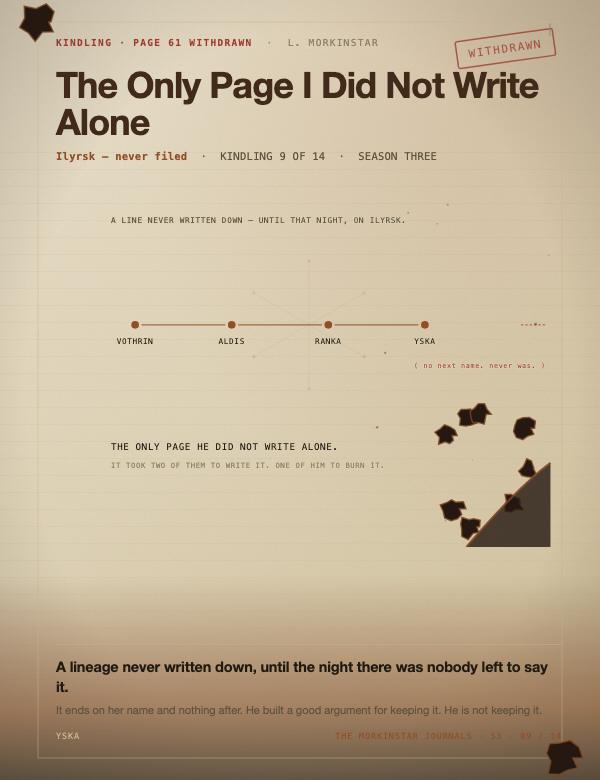
Kindling · page 61 withdrawn
Page sixty-one, my dear readers, is the only page in this case that is not entirely mine, and I have known that since the night it was written. I am not going to make a whole thing out of it before I have told you what is on it. In order, the way I am supposed to be doing everything now.
I was on a small wet world called Ilyrsk, between two other pieces of business that week, the kind of stop that never earns its own entry number. My transport back up was grounded for weather, and I was billeted for the night with an old woman named Yska, who could not sleep, and who asked me, past midnight, whether I was the kind of man who wrote things down for a living.
I said I was. It seemed a safe thing to admit to a stranger at that hour.
She said good, and told me to fetch whatever I wrote with. She had one thing left to say, was not sure she would have the voice for it twice, and there was nobody left on Ilyrsk whose ear it belonged to.
What she had was a line. Her people have a word for it my rig only half rendered, and I am not going to guess at somebody else's private word for you. It is a lineage, recited whole, mother to child, at a naming, never written down. Not forbidden. Simply never done, because writing a thing fixes it, and the whole point of this one is that it only exists while somebody is still saying it. Nobody was left on Ilyrsk to say it to.
So she gave it to me instead. She talked, I wrote, stopping when she stopped. Twice I asked her to repeat a syllable I was sure I had rendered wrong, and both times she gave it back exactly the same, patient in a way that told me she had decided early on that the page mattered more than what she thought of a stranger asking her to repeat herself.
It ends on her own name. I checked that with her twice, and both times she confirmed it without a beat of hesitation. The line does not end on her name because that is where she stopped talking. It ends there because that is where the line is. I asked whether I had simply missed one in the dark. No. That is all there is. Write it down anyway.
So the page reads, at the very end of it: Vothrin, who bore Aldis, who bore Ranka, who bore Yska. And then nothing, where a line like this has always expected one more name and has never once gone without one, until that night, in a house I could not find again, on a world I only remember because I wrote its name at the top of the page out of habit, before I knew the evening would be anything at all.
I could not tell you, sitting here, what colour that room was. I noticed that just now, reaching for it, and it was simply not there. I am going to keep going rather than decide what that means.
The corners of this page are softer than the pages either side of it. I have read this one more than almost any other in the case. Every mark on it is in my own hand, the way every mark here is, and every time I read it back it arrives in her voice and not mine, which does not happen with the other eighty-nine, not once, not even the ones about people I loved far more than a stranger I met for one grounded evening. I noticed that the first time. I noticed it again just now, and both times stopped short of finishing what that means, because I suspect that if I ever did finish it I would not be able to put this page in the fire. It has to go in with the rest of them. No exceptions I get to argue my own way into.
Which brings me, because I try to stay honest even at my own expense, to the argument I built for exactly that.
It is a good one, and I want you to know that before I tell you why it does not matter. The rule, since Cendre, has always been that what survives has to hold something nobody has ever written down before. Every other page in this case is a thing I simply had not gotten around to writing, which is a weaker claim than it sounds. This page is different in kind. Nobody, anywhere, had this line in ink before I put it there, and she told me herself it was built never to be. If the rule is truly about the never written, page sixty-one is the most qualified page I own, more qualified than a page I write blank tonight and call new for no better reason than that nothing has happened to it yet.
It is, I promise you, a better argument than I usually manage this late in an evening.
And I built it too well, and far too fast, and I have watched the Directory construct arguments exactly that clean for exactly as long as I have worked for it, always in service of whatever let somebody keep what they already wanted. A rule that bends itself, on its one exception, precisely toward the page I would have chosen anyway with no rule at all, is not a rule I am applying. It is a permission I wrote myself and dressed up as one.
What I would actually be keeping, if I kept this one, is the only proof in this case that I was ever, even once, not alone in the room while it was being written. That is a real thing to want. I am not going to pretend it is not. But it is a want about me, and this case was never built to end with one of those still in it.
So. Page sixty-one, into the fire, with everything that went before it and everything still waiting its turn. It took two of us to write it, and it only takes one of us to burn it. I am telling myself, doing it, that this is not a comment on anything.
There. Page sixty-one withdrawn.
I do not expect the rest to be this hard. I have been wrong about that before, on this fire, more than once.