The Directory · ENTRY #2250 · Grïnjdarlay, Alpha Axmoiri
The Ninety-Nine Names Of Silence
1,891 words · about 9 min
Back to The Morkinstar Journals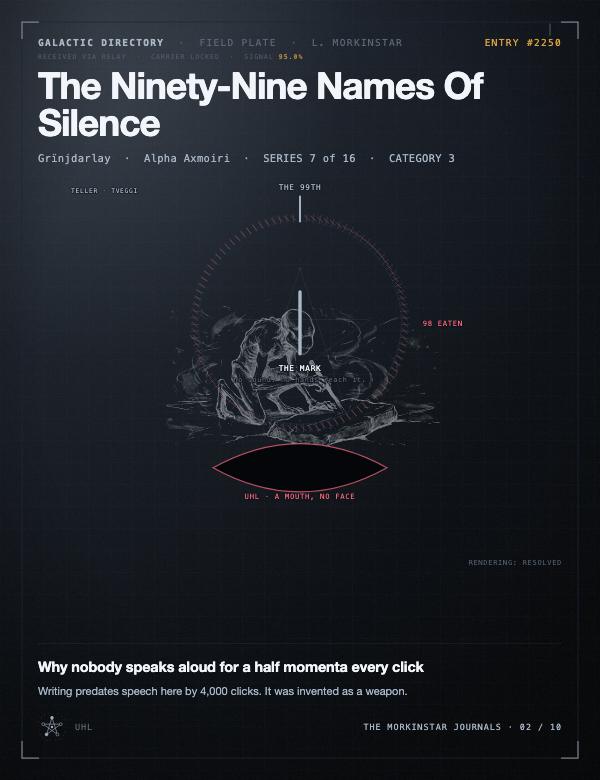
RELAY · GALACTIC DIRECTORY
Entry #2250 · Series 7 of 16, Alpha Axmoiri System
STATUS · RECEIVED
Greetings again, my dear readers. Lu'kifær Morkinstar back with you, and this is Journal Entry #2250, the 7th from my run through the Alpha Axmoiri Planetary System. Some of you wrote in after my Exxobar entry asking whether there was anywhere colder in that system. There is. I went. I regret it. Today's entry comes to you from the 3rd planet, Grïnjdarlay.
I mentioned Grïnjdarlay in passing three entries ago as the benchmark for "harsh". I want to walk that back, because "harsh" implies the planet is doing something to you, and Grïnjdarlay isn't. Grïnjdarlay is entirely indifferent to you, which is worse. It is a small dense world with a thin, dry, screaming atmosphere and an axial tilt of almost nothing, so there are no seasons in the way most of you would recognise them. There is only cold, and then a slightly different cold. The Galactic Directory lists the inhabitants as "Grïnjdarlin". They call themselves the Vöskh, which my translation rig renders as "the counted", and I want you to hold on to that word because it is going to matter in about nine paragraphs.
Grïnjdarlay is a Category 3 world. No spaceflight, plenty of writing. In fact, and this is the thing that made me change my travel plans and stay an extra momenta, they have rather a lot of writing. Their written language predates their spoken one by roughly 4000 clicks*.
Read that again. Their writing is older than their speech.
I have surveyed 2249 entries worth of cultures at this point, my dear readers, and every single one of them learned to talk first. Grïnjdarlay learned to write first, and the reason why is the legend I am here to give you.
Once a click, for a half momenta, no Vöskh says a single word out loud. Not one. Infants are held with a warm palm over the mouth. The sick are sedated. Anyone who cannot control themselves is taken out onto the ice and left with supplies and a marker flag until it passes. And this is not considered cruel by them, and after a momenta on that planet it stopped seeming cruel to me either. They call this period the Ösk. Everything that must be communicated during the Ösk is written, which is why every Vöskh dwelling has more chalk in it than food.
Here is why.
Many milgalaxals ago, in what the Vöskh call the Long Reckoning, the world of Grïnjdarlay was held between 14 gods and 14 monsters.
(Fourteen and fourteen. Which is, and I am noting this only because I am a thorough sort of correspondent and not because I think it means anything, the exact census I reported to you from Exxobar. Two worlds, one system, no contact between them, same headcount. The number 14 does have a way of turning up, and yes, before any of you write in, I am aware my rig has a bad habit of rounding foreign counts into shapes I already recognise. Moving on.)
Of those, the one that concerns us is the god Ösrun, called the Namer, and the monster called Uhl.
The Vöskh describe Ösrun in enormous detail. Height, gait, the sound of him arriving, the specific grey of his hands. Uhl they describe in four words, which translate to "a mouth, no face."
The theology of Grïnjdarlay runs on a single rule, and it is a rule I have not encountered anywhere else in this system. A thing exists for exactly as long as its name is in use. Not as long as it is remembered fondly. Not as long as it is loved. As long as somebody is actively using the name. Stop saying it, and the thing thins out. Say it wrong for long enough and the thing goes wrong to match.
And Uhl ate names.
Not people. Not cities. Names. Uhl would find the word for a river and swallow it, and the river would still be there for a little while, running and cold and full of fish. And then somebody would go to point at it and find they had nothing to point with, and by the next morning there would be a dry bed and nobody troubled by it. That is the horror the Vöskh built their whole culture around: not that things are destroyed, but that they are removed so completely that nobody is left inconvenienced by the gap.
[Fun Grïnjdarlay Fact #4- The Vöskh have 31 distinct words for the feeling of knowing you have forgotten something without being able to say what. Galactic Standard has zero. I checked twice, and then I checked with the Directory's linguistics desk, who were extremely rude about it and then quietly confirmed I was right. Doesn't get me anywhere. I guess I just like being right.]
Ösrun's answer to Uhl was not a weapon. This is the part I like.
Ösrun went to every single thing on Grïnjdarlay, every stone and animal and river and person, and he gave it ninety-eight extra names. So that everything on the planet had ninety-nine.
Uhl, being a mouth and nothing else, could only eat one name a day from any single thing. And a Grïnjdarlin click contains, by their own reckoning, ninety-eight days of what they call open season, plus the half momenta of the Ösk, during which Uhl is too full to move and sleeps.
Do the arithmetic with me. Ninety-eight days, ninety-eight names. Uhl works his way through your rock, your river, your grandmother, one name at a time, all click long, and on the last day of the season there is exactly one name left, and then Uhl falls asleep for a half momenta and everything is regenerated back to ninety-nine and the whole miserable business begins again.
So the Ösk is the safe period. Uhl is asleep.
The catch, and there is always a catch, is that Uhl sleeps lightly, and the one thing that wakes him is hearing a name spoken aloud. If a Vöskh speaks during the Ösk, they are speaking the ninety-ninth name. The last one. And Uhl wakes up hungry with the name already ringing in the air, and takes it, and the thing goes.
Hence: silence. A whole world holding its breath so that nothing gets pointed at.
Now. The witness.
There was a Vöskh child called Tveggi, born without the auditory organ that runs along the Vöskh jawline. In most cultures I have reported from, this would have made her an object of pity. On Grïnjdarlay, the term for her condition translates, very precisely, as "born full", because the Vöskh reasoned that a person who cannot hear names being eaten is a person who is not losing anything.
And they were right, which is the whole hinge of this legend.
When Uhl ate a name, everyone who could hear lost the name and lost the memory of the count. They would know they were somewhere in the season. They could never agree on where. Every tally the Vöskh kept came out different, because the tally was written in speech, and speech is what Uhl eats.
Tveggi could not hear, so nothing was taken from her. She kept the count. She was the only accurate clock on the planet.
And at some point in that first Long Reckoning, sitting on the ice with a burnt stick and a flat stone, Tveggi worked out the thing that Ösrun in all his grey enormity had not: that a name does not have to be a sound.
She scratched a mark.
The mark meant the thing. It was a name by every rule the world ran on, and it was completely silent, and it sat on a rock where nobody had to hold it in their mouth. And Uhl, my dear readers, is a mouth and no hands.
He could not reach it. He still cannot.
The Vöskh say Ösrun came to her that night, and that he understood immediately what she had done, and that he then did the only thing left that would work. Because a mark is only a name if somebody is using it, and one child with a stick is not a world.
So Ösrun split himself in half. One half went and put its arms inside Uhl's mouth and held it open, which is a thing you can do to a mouth if you have decided you are no longer going to need your arms. The other half walked Grïnjdarlay for a full click, from settlement to settlement, teaching the marks, until every Vöskh alive could write.
Neither half came back.
And this is why the Vöskh have no name for their god. Not a forgotten one. Not a taboo one. They never had one. Ösrun gave ninety-nine names to every single thing on that planet and by the arithmetic of the story there was nobody left to give him one, and by his own rule, a thing without a name in use does not persist. He wrote everyone else into permanence and could not sign his own work.
What the Vöskh have instead is the mark. A single vertical scratch, the first thing Tveggi ever cut into stone, which appears at the top of every document on that world, on every dwelling, on the flags they plant beside the people they leave out on the ice. It is not a letter. It does not have a sound. If you ask a Vöskh what it says, they look at you as though you have asked what a wall says.
Every Vöskh child is taught to write before they are taught to speak. Not for elegance. Not for literacy rates. Because speech is the thing that can be taken from you, and the mark is the thing that cannot, and on Grïnjdarlay you are given the safe one first.
Is there truth in it? You know my position by now. I do not prove and I do not disprove. I report.
Although I will say this, and then I will get off my crate. I spent a half momenta on that planet in total silence, filing everything I have just told you as scratches on a slate, in a room where the only sound was the wind doing its work outside. And on about the fortieth day it occurred to me that I have been doing Tveggi's job for 2250 entries. Somebody who cannot personally hold on to any of it, sitting slightly outside, keeping the count in marks.
I am not saying that means anything. I am saying I noticed it, and that it kept me up.
This is Lu'kifær Morkinstar concluding Journal Entry #2250, Series 7 of 16 from the Alpha Axmoiri System. Go and say somebody's name out loud today. You have the luxury.
Terminologies:
- Click — Equivalent to 1 Hellheim or 2 Earth Years.
- Momenta — Equivalent to 1 Purgaheim or 50 Earth Days.
- Milgalaxal — Equivalent to 2228 Hellheims or 2455 Earth Years. (Yes, that conversion does not multiply out. No, the Directory has not fixed it. I have filed four requests.)
- Ösk — The Grïnjdarlin silent period. Literally "the held mouth".
- Vöskh — Self-term of the Grïnjdarlin. "The counted."